Frequent FOIA Failures: City of Newport News Under Scrutiny for Blocking Public Access
Public records are not privileges granted by government—they are the property of the citizens who fund and empower these agencies. The Virginia Freedom of Information Act (FOIA) exists to ensure transparency, holding police, sheriffs, firefighters, and other public servants accountable. Yet in Newport News, repeated delays, denials, high fees, and creative workarounds suggest a culture more focused on shielding itself than serving the public.
 press
press 
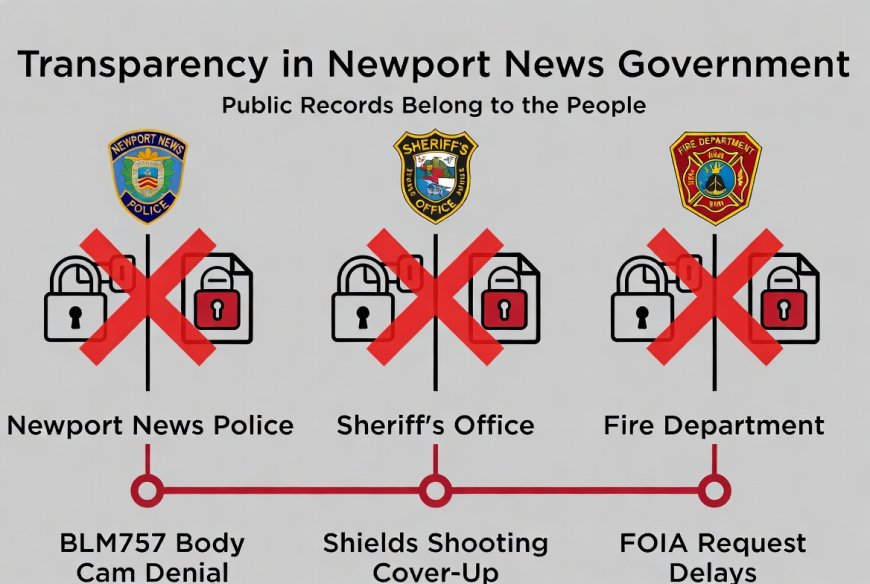
In one of the most publicized recent examples, activists with BLM757 filed FOIA requests for body camera footage, incident reports, and related records following an incident involving Newport News Police Department (NNPD) officers and minors after prom. Reports indicate officers drew weapons on the youths.
According to BLM757 posts, NNPD denied the request in under 24 hours, citing exemptions related to ongoing investigations. They also denied similar requests from victims pursuing litigation. Critics highlighted that other states routinely release body cam footage without such barriers, raising questions about selective application of exemptions.
This case fits a broader pattern where footage that could provide crucial accountability—especially in use-of-force or public safety incidents—is withheld, leaving citizens and alleged victims in the dark.
Shields Shooting Response (2024): Officials declined to release over 100 pages of documents related to a botched response to a shooting victim who later died. Internal text messages revealed city officials, including the City Manager, advising on ways to route documents through the City Attorney to claim attorney-client privilege and avoid FOIA disclosure.
This incident involved both police and fire/EMS responses, drawing scrutiny to how the departments handled the case and subsequent internal reviews.
$2 Million Settlement Without Public Vote: In a wrongful conviction case, the Newport News City Council authorized a substantial settlement in closed session without a required public vote. FOIA experts noted this may violate state law on transparency for such expenditures.
FOIA Logs and Fees: While Newport News provided a full FOIA log relatively transparently in one comparative request across Hampton Roads cities, broader issues persist with costs, redactions, and delays across Virginia agencies. High processing fees and claims of burdensome requests often deter average citizens from pursuing records.
Newport News Police Department policy acknowledges FOIA obligations but emphasizes exemptions, particularly for criminal history, juveniles, and ongoing investigations. While some protections are legitimate, critics argue they are applied too broadly, especially for body-worn camera footage that could clarify disputed incidents.
The Newport News Sheriff’s Office maintains a FOIA contact but, like many agencies, operates within the same framework where delays or denials can effectively bury accountability. The Fire Department has faced questions in joint responses with police, such as in the Shields case.
Why This Matters: Government Works for the People
Virginia FOIA law presumes openness: records should be available unless a specific exemption applies, and even then, it must be narrowly construed. Failure to respond in time is itself a violation.
When police, sheriffs, and fire departments—agencies with significant power over life, liberty, and safety—routinely obstruct access:
- It erodes public trust.
- It hinders journalistic oversight and community advocacy.
- It protects potentially problematic conduct from scrutiny.
- It contradicts the principle that these are public servants using public funds.
Citizens have tools: petition courts to compel compliance, contact the FOIA Council for advisory opinions, or escalate through media and public pressure. Groups like BLM757 demonstrate how persistent requests and publicizing denials can force attention.
Call for Reform and Accountability
Newport News, like many localities, should adopt stronger internal policies favoring proactive disclosure—especially for body camera footage in non-sensitive cases, use-of-force reports, and internal investigations with public safety implications. Reducing unnecessary fees and streamlining responses would align with the spirit of open government.
Public officials should remember: these records belong to us. The police, sheriff, and fire department exist to protect and serve—not to self-protect at the expense of transparency. Frequent FOIA failures aren’t just bureaucratic hurdles; they’re barriers to the democratic oversight that keeps power in check.
Citizens deserve better. Demand it.