
Metro Train in Newport News? Is it even possible?
Yes, it is technically doable to add limited local/commuter-style passenger rail service (sometimes loosely called “metro”) on existing CSX tracks in Newport News, Virginia, with 3–5 stations phased over time—but it faces significant operational, capacity, cost, and institutional hurdles. It would not be a classic high-frequency metro (exclusive right-of-way, grade-separated, very frequent service) and is more accurately described as enhanced intercity/commuter rail or hybrid passenger service sharing freight tracks. Total estimated cost which includes adding 5 stations, upgrading tracks and other various costs - $100–200 million
Existing Rail Context
Newport News sits on the CSX Peninsula Subdivision (roughly 82 miles from Newport News to Richmond). This line carries:
- Heavy freight, especially coal to the Newport News Marine Terminal / port facilities.
- Amtrak Northeast Regional service (currently 2 daily roundtrips to/from Washington, D.C., via Williamsburg and Richmond; a third was delayed until after ~2030 due to Long Bridge construction).
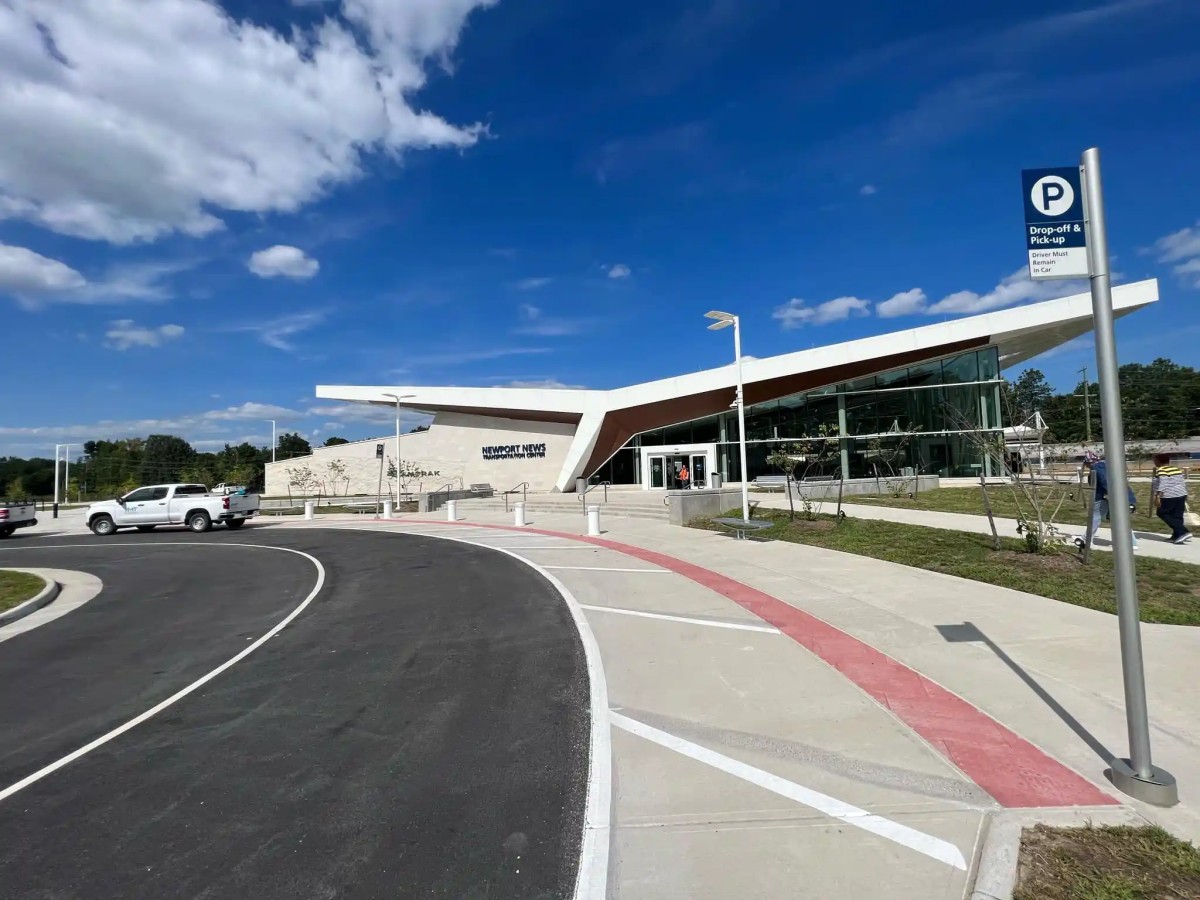
A new multimodal Newport News Transportation Center (opened August 2024 near the airport on Bland Boulevard) serves Amtrak, HRT buses, and other connections. An older downtown-area station was closed. The line is mostly CSX-owned (unlike parts of the I-95 corridor where Virginia purchased substantial track/right-of-way under the Transforming Rail in Virginia program).
Hampton Roads Transit (HRT) operates the Tide light rail only on the Southside (Norfolk area). On the Peninsula, transit emphasis is on bus optimization, microtransit, and potential Bus Rapid Transit (BRT). There are no active local rail “metro” plans for Newport News itself.
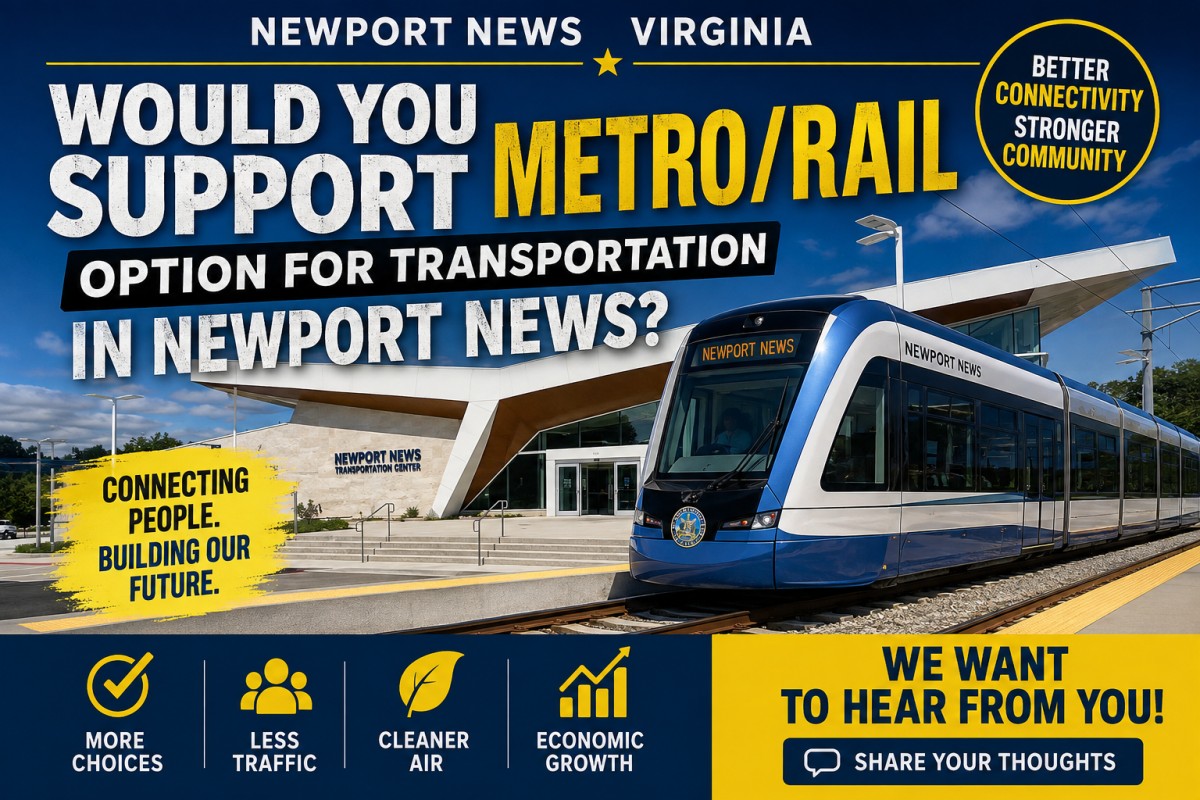
VOTE NOW - WOULD YOU SUPPORT LIGHT RAIL IN NEWPORT NEWS?
Feasibility of Adding 3–5 Stations
Technically feasible via trackage rights or operating agreements with CSX (the model used by Amtrak and Virginia Railway Express elsewhere). Key requirements and constraints:
- Capacity and freight priority: The line is partially single- and double-tracked with freight (especially coal) operations that typically receive priority. Frequent local passenger stops would require sidings, signaling upgrades (including Positive Train Control), and careful scheduling to avoid conflicts. Daytime windows can be limited.
- Stations: Platforms (ideally high-level for accessibility/level boarding where possible), access, parking, and pedestrian connections. Possible locations could leverage the existing Transportation Center, areas near downtown/City Center, Oyster Point/tech corridors, or other activity centers along the roughly linear corridor. Phasing (e.g., start with 1–2, add later) reduces upfront risk.
- Regulatory/institutional: Agreements with CSX on liability, compensation, maintenance, and capacity preservation are essential. Coordination with the Virginia Passenger Rail Authority (VPRA), Department of Rail and Public Transportation (DRPT), Amtrak, HRT, and the city would be required. Environmental review, grade-crossing safety, and FRA compliance apply.
- Service model: Peak-period or limited-frequency local trains (perhaps connecting to Amtrak) are more realistic initially than all-day high-frequency metro service. True metro characteristics would likely need dedicated tracks or major separation, which is far more expensive.
- Precedents: Virginia has successfully expanded passenger service on shared freight corridors and bought capacity in other places. Similar shared-use passenger additions occur elsewhere in the U.S., though often with substantial host-railroad mitigation.
Challenges that could make it difficult or slow: Freight volume and CSX priorities, potential low ridership relative to cost (Newport News population ~180k in a car-oriented region), competition from buses and planned BRT/express lanes, and the need for ongoing operating subsidies. Regional plans prioritize intercity Amtrak growth, highway express lanes, and bus improvements over new local rail on the Peninsula.
Phasing over years (studies → agreements → initial stations/service → expansions) is realistic and common for such projects.
Rough Cost Estimates
Precise costs require a formal study (ridership, engineering, CSX negotiations). Order-of-magnitude figures based on comparable U.S. projects (commuter rail on existing freight tracks, station additions, light upgrades; adjusted conceptually to recent dollars):
- Individual stations: Simple side platforms/access improvements often $5–20+ million each. Fuller intermodal or high-amenity stations can reach $30–50+ million (the recent Newport News Transportation Center package was ~$53 million total, including platform and related work with multiple funding sources).
- Track/signaling/capacity upgrades: Highly variable. Basic improvements or PTC/signaling can be in the low millions per mile; adding sidings, double-tracking segments, or major grade-crossing work is substantially higher. Shared-use projects without full new tracks are cheaper than greenfield or dedicated lines.
- Overall for a short local corridor (e.g., 10–20 miles with 3–5 stations): Likely tens of millions to low hundreds of millions for capital (stations + modest upgrades + rolling stock share + contingency). Full high-capacity dedicated or heavily upgraded service would be higher. Rolling stock, a maintenance/layover facility, and soft costs (design, environmental, project management) add significantly.
- Comparables: Commuter-rail-style projects using existing tracks often fall in ranges well below full light-rail or heavy-rail construction (U.S. light rail frequently $50–100+ million per mile all-in for new guideway; shared freight conversions can be lower when minimal new track is needed). Vehicle and annual operating/maintenance costs are separate and recurring (often requiring subsidies).
Funding would likely mix federal grants (e.g., CRISI, RAISE/BUILD-style, FTA programs), state sources (DRPT/VPRA), local contributions, and possibly regional bodies. Operating costs would need ongoing support.
Bottom Line and Path Forward
It is doable as a phased, limited passenger service addition rather than a full metro system, especially if focused on connecting key activity centers and leveraging the existing Amtrak infrastructure and the new Transportation Center. Success depends on CSX cooperation, demonstrated ridership potential, political will, and funding. No current plans appear to pursue this specifically for local Newport News service—the emphasis remains intercity rail expansion (post-Long Bridge ~2030) and bus/BRT improvements.
Recommended next steps for serious consideration: A feasibility/ ridership study coordinated with VPRA/DRPT/HRT/CSX; engagement with the city and regional planning bodies (HRTPO); and review of the Commonwealth Corridor or related passenger rail planning processes. Costs and timelines would firm up significantly after engineering and host-railroad discussions.
Total estimated capital cost: roughly $50–250 million (order-of-magnitude, in mid-2020s dollars), for a basic phased local/commuter-style passenger service with 3–5 stations on existing CSX tracks in Newport News. A more robust version with significant capacity upgrades could push toward the higher end or beyond.
Breakdown of the Estimate
This is not a full new light-rail or metro line with exclusive right-of-way. It assumes shared use of the existing CSX Peninsula Subdivision tracks, with modest upgrades, new or improved stations, and limited new infrastructure. Exact figures would require a formal feasibility/engineering study + negotiations with CSX.
| Component | Low-End Estimate | High-End Estimate | Notes |
|---|---|---|---|
| 3–5 Stations (platforms, access, parking, basic amenities) | $20–50 million | $60–150 million | Simple side platforms often $5–20M each; fuller intermodal-style stations (like the recent Newport News Transportation Center package ~$53M total) cost more. Phasing starts cheaper. |
| Track, signaling, PTC, sidings, grade crossings | $15–50 million | $50–100+ million | Shared freight tracks need safety/capacity work. Minimal upgrades are lower; adding sidings or double-tracking segments raises costs. |
| Rolling stock, layover/maintenance, soft costs (design, environmental, contingency, project management) | $15–50 million | $40–80+ million | Share of vehicles + contingency typically 20–40% of project. |
| Rough Total Capital | ~$50–150 million | ~$150–250+ million | For a short local corridor (roughly 10–20 miles of relevant track). |
Key Context for the Numbers
- Comparable real projects: The new Newport News Transportation Center (Amtrak + multimodal) cost about $53 million. Simple station additions or upgrades on existing lines are often far cheaper individually. Shared-use passenger additions (without full new tracks) are generally much less expensive than greenfield light rail (which frequently runs $50–100+ million per mile).
- What is not included: Major exclusive right-of-way construction, full electrification, high-frequency metro-level infrastructure, extensive double-tracking, or large new bridges. Those would multiply costs into the high hundreds of millions or more.
- Operating costs (separate and ongoing): Annual O&M for limited service could easily run several million dollars per year and would likely require subsidies.
- Phasing helps: Starting with 1–2 stations and limited peak service keeps early costs toward the low end; later stations/upgrades can be added over time.
Important Caveats
These are planning-level ranges drawn from U.S. station projects, shared freight-track passenger additions, and Virginia Amtrak-related work. Actual costs depend heavily on:
- Exact station locations and design standards
- How much capacity mitigation CSX requires
- Environmental, grade-crossing, and accessibility needs
- Inflation, labor, and material prices at the time of construction
- Funding sources and contingencies
A professional feasibility study (coordinated with VPRA, DRPT, CSX, and the city) would produce much tighter numbers. Until then, $100–200 million is a reasonable central planning figure for a modest 3–5 station local service.
What's Your Reaction?
 Like
0
Like
0
 Dislike
1
Dislike
1
 Love
0
Love
0
 Funny
0
Funny
0
 Wow
0
Wow
0
 Sad
0
Sad
0
 Angry
0
Angry
0

Press What Matters affiliate