The Slow Extinction of Newspapers: When the Dinosaurs of Local News Struggle to Survive
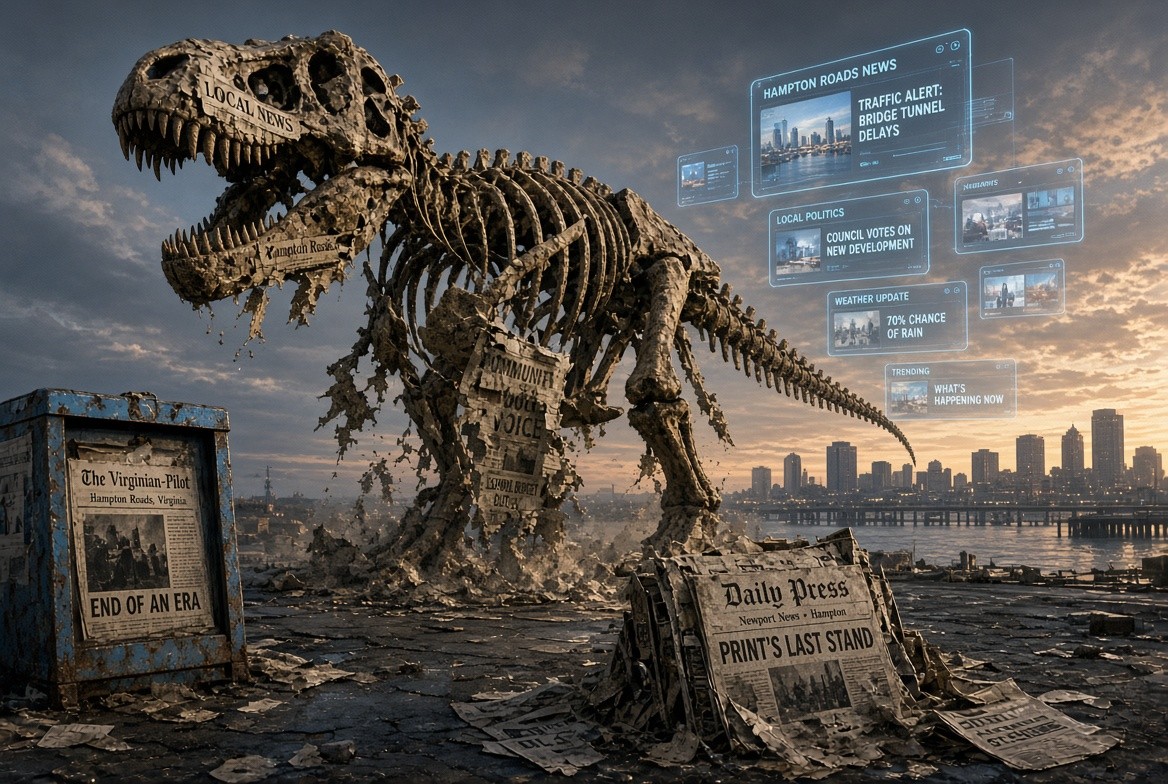
Newspapers once ruled the information landscape. They were the primary source of local accountability, community identity, and daily truth for generations of Americans. Today, many of them resemble dinosaurs: powerful in their time, slow to adapt, and increasingly vulnerable in a world that moved on without them.
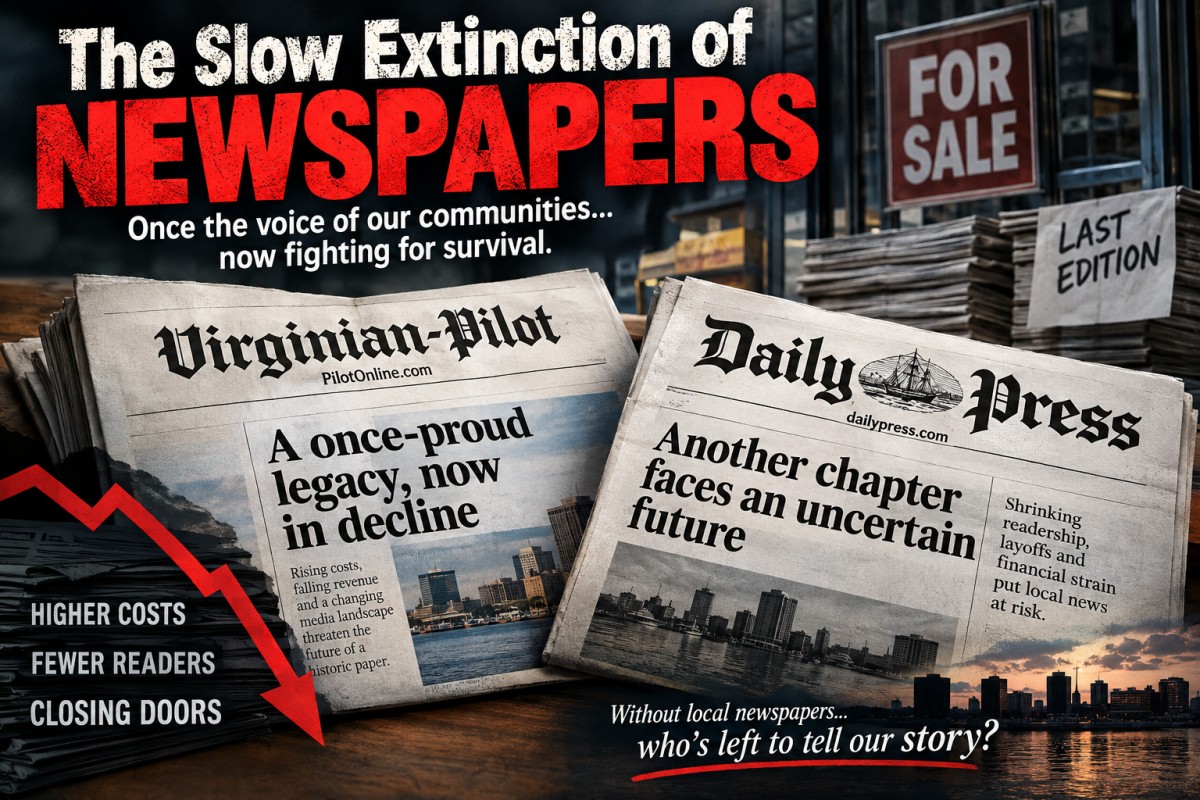
The numbers are stark. Since 2005, the United States has lost nearly 40% of its local newspapers—more than 3,000 titles. Roughly two papers close every week. Print circulation has plummeted by an estimated 70% or more. Advertising revenue, the industry’s traditional lifeblood, has collapsed by more than 80% from its peak. Newspaper employment has fallen by roughly three-quarters. Tens of millions of Americans now live in “news deserts”—counties with limited or no reliable local journalism.
The causes are well known and mutually reinforcing. Classified advertising migrated to Craigslist and other free online platforms in the early 2000s. Display advertising followed audiences to Google, Meta, and digital platforms that offered better targeting and measurement. Readers, especially younger ones, abandoned the morning paper for smartphones, social media feeds, and free digital content. Newspapers were late to build sustainable digital businesses, and many never fully recovered from the Great Recession or the advertising shock of the COVID-19 pandemic.
The result is a hollowed-out industry. Even papers that remain often operate as “ghost newspapers”—thin print editions or digital shells with skeleton staffs, reduced local coverage, and heavy reliance on wire copy or aggregated content. Linear television and radio news are now following a similar trajectory of audience loss, though newspapers led the decline.
A Case Study in Hampton Roads: The Virginian-Pilot and Daily Press
Two longtime Virginia papers illustrate the pattern. The Virginian-Pilot, founded in 1865 and long Virginia’s largest daily, and the Daily Press of Newport News (founded 1896) once competed vigorously across the Hampton Roads region. Both were solid local institutions with deep roots.
Tribune Publishing (then Tronc) bought the Daily Press decades earlier and acquired The Virginian-Pilot in 2018 for $34 million from its longtime family owners. In 2021, hedge fund Alden Global Capital took full control of Tribune. Alden has a well-documented playbook: acquire distressed papers, cut staffing aggressively, sell real estate, centralize operations, raise subscription prices, and extract cash with minimal reinvestment in journalism. Critics call it “vulture capitalism” or a liquidation strategy. Supporters argue the firm steps in when no one else will and keeps some form of the paper alive longer than pure market forces might.
Under this ownership, the two papers effectively merged operations under the Virginia Media banner. They share offices in Newport News after The Pilot sold its historic Norfolk headquarters. Staffing has been repeatedly reduced. In 2024, journalists at the papers joined a one-day strike protesting conditions under Alden, noting the newsroom had shrunk dramatically. In June 2025, the company eliminated the editor-in-chief position held by Kris Worrell, citing “difficult business conditions.” Senior editors absorbed expanded duties. No further immediate editorial cuts were announced at the time, but the signal was clear.
Circulation figures from earlier years already showed steep drops from their historic highs. Coverage of outlying areas has thinned. The papers still publish daily (print and digital), win awards, and produce local reporting on elections, government, military issues, and community life. They are not closed. But they are smaller, leaner, and under continuous financial pressure—classic examples of the industry’s painful adaptation rather than outright extinction.
Why It Matters Beyond Nostalgia
The loss is not merely sentimental. Local newspapers historically provided the “iron core” of civic information: school board meetings, zoning decisions, crime, business development, and government accountability. Research links newspaper closures or severe cutbacks to lower voter turnout, higher municipal borrowing costs, increased polarization, and the spread of misinformation. When no one is watching City Hall regularly, dysfunction and corruption find more room to grow.
Digital startups, nonprofit newsrooms, public radio, and independent local sites have filled some gaps, particularly in larger cities. Yet they have not scaled fast enough or evenly enough to replace what has been lost, especially in smaller and rural communities. Many remain fragile, grant-dependent, or concentrated in urban areas.
Can the Dinosaurs Evolve?
Some papers have found paths forward through digital subscriptions, events, membership models, or nonprofit conversion. Independent or locally owned outlets sometimes fare better than those under distant financial owners focused on short-term extraction. A few markets have seen energetic nonprofit responses precisely because of aggressive cost-cutting by firms like Alden.
Still, the structural headwinds remain strong. Audience habits have changed permanently. Advertising economics favor platforms over publishers. Print is a niche product. The industry continues to shrink even as some individual titles stabilize or innovate.
The Virginian-Pilot and Daily Press are not yet extinct. Like many surviving newspapers, they are diminished versions of their former selves—still moving, still reporting, but operating in a far more constrained and uncertain environment. Whether they, and the broader industry, can evolve into sustainable modern forms of local journalism or continue a long, slow decline remains one of the central questions for American civic life.
The dinosaurs of news did not disappear overnight. They are still here, smaller and harder to spot, navigating a landscape that no longer favors them. The question is how much of the valuable work they once did will survive the transition.
Editors Note: There is no longer a job titled editor, publisher, writer, coder, graphic designer, etc. AI does it better, faster and without attitude. Not to mention it's free for the most part. If you don't use AI to your advantage -- you will quickly get shut out. Try to forget about all the years seemingly wasted learning all the tricks of the trade and other tools you used to use like Word, Photoshop. And don't blame us, I spent 20+ years learning how to code -- all shot to shit!
Frequently Asked Questions
What's Your Reaction?
 Like
0
Like
0
 Dislike
0
Dislike
0
 Love
0
Love
0
 Funny
0
Funny
0
 Wow
0
Wow
0
 Sad
0
Sad
0
 Angry
0
Angry
0
Press What Matters allows anyone to become a citizen journalist! Get paid per click for all of your news articles, stories or videos.